Importance Sampling and SMC
This notebook demonstrates the importance sampling (IS) and Sequential Monte Carlo (SMC) tools in psiphy.mcmc.importance_sampling, applied to the built-in toy models.
What is importance sampling?
We want to draw samples from a target \(p(\theta | x)\) but can only evaluate it up to a constant. IS draws samples from a tractable proposal \(q(\theta)\) and corrects with weights:
The effective sample size (ESS) measures how much information the weighted set carries:
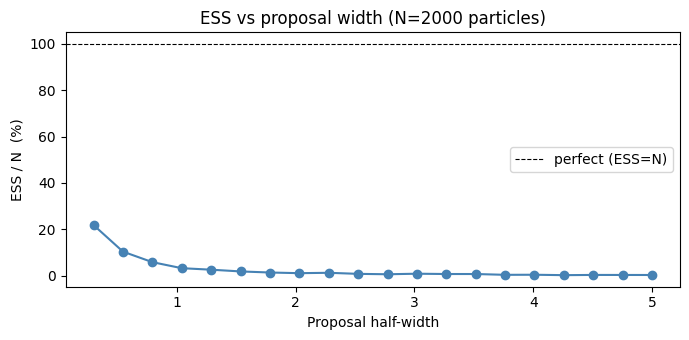
Low ESS means the proposal is a poor match for the posterior — most weight falls on very few particles.
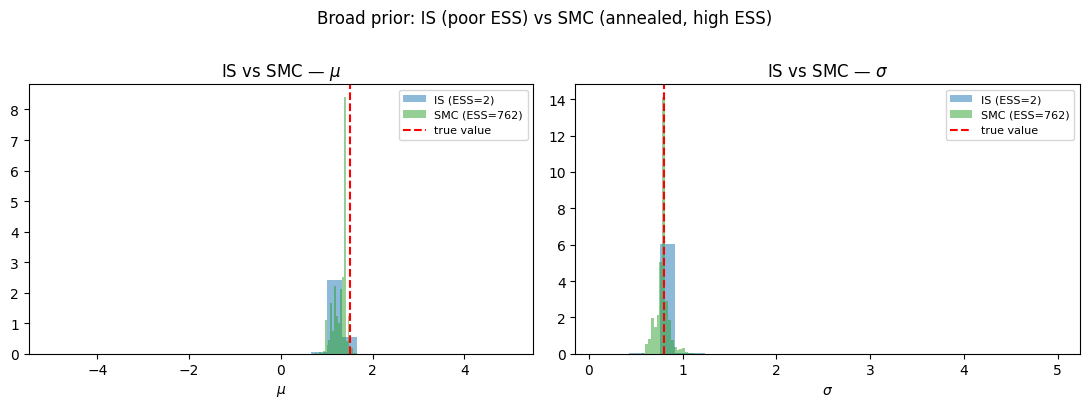
SMC fixes this by annealing from the prior to the posterior through a sequence of tempered targets, resampling and applying MCMC moves when ESS drops too low.
Output format
importance_sampling, sequential_importance_sampling and sequential_monte_carlo (SMC) all return a dict:
Key |
Meaning |
|---|---|
|
weighted particles and their normalised weights (aligned) |
|
particles resampled by weight — use for plain means, stds, predictive draws |
|
effective sample size |
|
log marginal likelihood (SMC; IS when |
Always pass samples together with weights to weighted statistics and plots.
[1]:
import numpy as np
import matplotlib.pyplot as plt
from scipy.stats import norm

from psiphy.mcmc import (
    UniformPrior,
    eff_sample_size,
    importance_sampling,
    sequential_importance_sampling,
    sequential_monte_carlo,
)
from psiphy.toy_models import GaussianSignal, NoisyLine

np.random.seed(42)
1 UniformPrior helper
UniformPrior wraps a box prior and provides sample(n) and log_prob(theta) — the two methods expected by importance_sampling and sequential_monte_carlo.
[2]:
prior = UniformPrior({'mean': (-5, 5), 'sigma': (0.1, 5)})
print('ndim  :', prior.ndim)
print('sample:', prior.sample(3))
print('log_prob in support  :', prior.log_prob([0.0, 1.0]))
print('log_prob out of support:', prior.log_prob([10.0, 1.0]))
ndim  : 2
sample: [[-1.25459881  4.7585001 ]
 [ 2.31993942  3.03342657]
 [-3.4398136   0.86437315]]
log_prob in support  : -3.891820298110627
log_prob out of support: -inf
2 Importance Sampling — GaussianSignal
Target: posterior \(p(\mu, \sigma \mid x)\) for a Gaussian signal with \(N=40\) observations.
[3]:
gs = GaussianSignal(N=40)
theta_true = np.array([1.5, 0.8])
x_obs = gs.simulate(theta_true)

print(f'x_obs  mean={x_obs.mean():.3f}  std={x_obs.std():.3f}  (true: {theta_true})')
x_obs mean=1.250 std=0.734 (true: [1.5 0.8])
[4]:
# Broad uniform prior — deliberate mismatch to show ESS degradation
prior_broad = UniformPrior([(-5, 5), (0.1, 5)])
log_posterior = lambda t: gs.log_prob(t, x_obs) + prior_broad.log_prob(t)

proposal_broad = prior_broad.sample(5000)
res = importance_sampling(log_posterior, proposal_broad)
s_broad, w_broad = res['samples'], res['weights']
ess_broad = eff_sample_size(w_broad)
print(f'Broad proposal  — ESS = {ess_broad:.1f} / 5000 ({100*ess_broad/5000:.1f}%)')
Broad proposal — ESS = 11.4 / 5000 (0.2%)
[5]:
# Tighter prior centred near the posterior — higher ESS
prior_tight = UniformPrior([(0.0, 3.0), (0.3, 2.0)])
log_posterior_tight = lambda t: gs.log_prob(t, x_obs) + prior_tight.log_prob(t)

proposal_tight = prior_tight.sample(5000)
res = importance_sampling(log_posterior_tight, proposal_tight)
s_tight, w_tight = res['samples'], res['weights']
ess_tight = eff_sample_size(w_tight)
print(f'Tight proposal  — ESS = {ess_tight:.1f} / 5000 ({100*ess_tight/5000:.1f}%)')
Tight proposal — ESS = 114.1 / 5000 (2.3%)
[6]:
# Analytic posterior on mean for comparison (sigma plugged in as sample std)
post_mean, post_sigma = gs.analytic_posterior(x_obs)

fig, axes = plt.subplots(1, 2, figsize=(11, 4))

mu_grid = np.linspace(0.5, 2.5, 300)

for ax, samples, w, label, color in [
    (axes[0], proposal_broad, w_broad, 'broad prior', 'C0'),
    (axes[1], proposal_tight, w_tight, 'tight prior', 'C1'),
]:
    ess = eff_sample_size(w)
    ax.hist(samples[:, 0], weights=w, bins=40, density=True,
            alpha=0.6, color=color, label=f'IS ({label}, ESS={ess:.0f})')
    ax.plot(mu_grid, norm.pdf(mu_grid, post_mean, post_sigma),
            'k--', lw=1.5, label='analytic posterior')
    ax.axvline(theta_true[0], c='red', lw=1.5, ls=':', label='true mean')
    ax.set(xlabel=r'$\mu$', title=f'IS — {label}')
    ax.legend(fontsize=8)

plt.suptitle('Importance Sampling: posterior on mean', y=1.01)
plt.tight_layout()
plt.show()
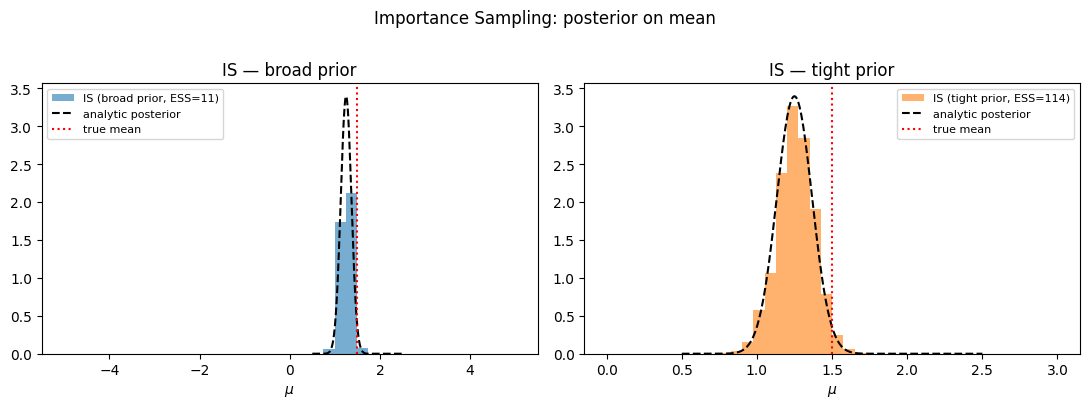
Key takeaway: the broad uniform proposal samples mostly from regions of low likelihood, yielding very few effective samples. A tighter proposal that overlaps the posterior better gives a far higher ESS and more accurate estimate.
Why is the posterior not centred on the true :math:`mu`? The posterior describes this data set. The 40 observed values have a sample mean that, by chance, lies about two standard errors below the true mean, and every correct method — including the analytic posterior — follows the data there. A single data set cannot reveal the truth more precisely than its own noise allows; whether a method is biased is a question about many data sets (Section 7).
[7]:
se = x_obs.std(ddof=1) / np.sqrt(len(x_obs))
print(f'sample mean = {x_obs.mean():.3f}, true mean = {theta_true[0]}, '
      f'standard error = {se:.3f}  ->  data offset = {(x_obs.mean() - theta_true[0]) / se:+.1f} sigma')
sample mean = 1.250, true mean = 1.5, standard error = 0.118 -> data offset = -2.1 sigma
3 Effective Sample Size as a diagnostic
[8]:
# Show how ESS changes with proposal width
half_widths = np.linspace(0.3, 5.0, 20)
ess_list = []

for hw in half_widths:
    p = UniformPrior([
        (theta_true[0] - hw, theta_true[0] + hw),
        (max(0.1, theta_true[1] - hw), theta_true[1] + hw),
    ])
    prop = p.sample(2000)
    res = importance_sampling(lambda t: gs.log_prob(t, x_obs) + p.log_prob(t), prop)
    _, w = res['samples'], res['weights']
    ess_list.append(eff_sample_size(w) / 2000 * 100)

fig, ax = plt.subplots(figsize=(7, 3.5))
ax.plot(half_widths, ess_list, 'o-', c='steelblue')
ax.set(xlabel='Proposal half-width', ylabel='ESS / N  (%)',
       title='ESS vs proposal width (N=2000 particles)')
ax.axhline(100, ls='--', c='k', lw=0.8, label='perfect (ESS=N)')
ax.legend()
plt.tight_layout()
plt.show()
4 Importance Sampling — NoisyLine
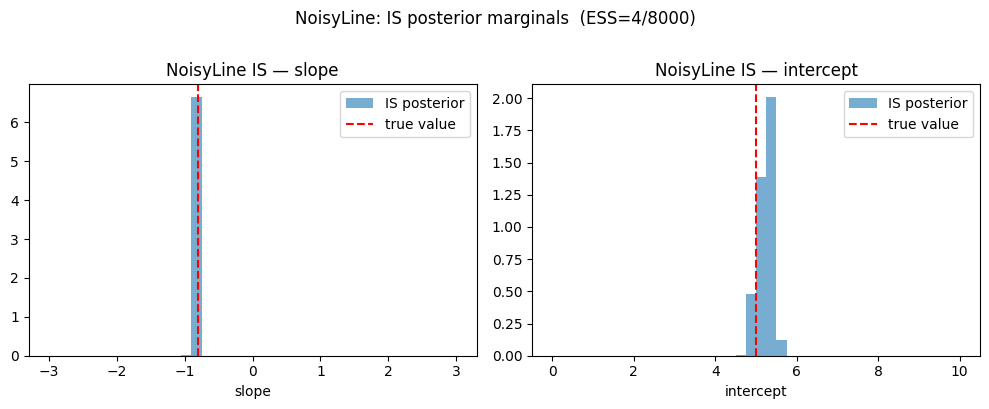
Two parameters: slope and intercept.
[9]:
nl = NoisyLine(Nx=40, noise_sigma=0.5)
theta_nl = np.array([-0.8, 5.0])
y_obs = nl.simulate(theta_nl)

prior_nl = UniformPrior([(-3, 3), (0, 10)])
log_post_nl = lambda t: nl.log_prob(t, y_obs) + prior_nl.log_prob(t)

prop_nl = prior_nl.sample(8000)
res = importance_sampling(log_post_nl, prop_nl)
s_nl, w_nl = res['samples'], res['weights']
ess_nl = eff_sample_size(w_nl)
print(f'NoisyLine IS  ESS={ess_nl:.1f}/8000  '
      f'slope={np.average(s_nl[:,0], weights=w_nl):.3f} (true {theta_nl[0]})  '
      f'intercept={np.average(s_nl[:,1], weights=w_nl):.3f} (true {theta_nl[1]})')
NoisyLine IS ESS=4.2/8000 slope=-0.832 (true -0.8) intercept=5.280 (true 5.0)
[10]:
fig, axes = plt.subplots(1, 2, figsize=(10, 4))

for ax, idx, name, true_val in [
    (axes[0], 0, 'slope', theta_nl[0]),
    (axes[1], 1, 'intercept', theta_nl[1]),
]:
    ax.hist(s_nl[:, idx], weights=w_nl, bins=40, density=True, alpha=0.6, label='IS posterior')
    ax.axvline(true_val, c='red', lw=1.5, ls='--', label='true value')
    ax.set(xlabel=name, title=f'NoisyLine IS — {name}')
    ax.legend()

plt.suptitle(f'NoisyLine: IS posterior marginals  (ESS={ess_nl:.0f}/8000)', y=1.01)
plt.tight_layout()
plt.show()
5 SMC — annealing from prior to posterior
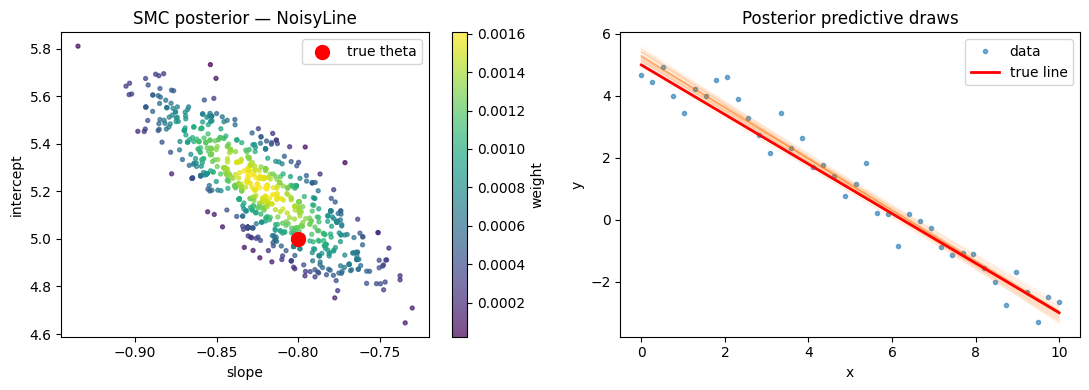
SMC overcomes the low-ESS problem by bridging from the prior to the posterior through tempered targets \(p_t \propto \text{prior} \times \mathcal{L}^{\beta_t}\). When ESS drops below a threshold, particles are resampled and a Gaussian random-walk MCMC move is applied to maintain diversity.
[11]:
# GaussianSignal with broad prior — compare IS vs SMC
prior_broad2 = UniformPrior([(-5, 5), (0.1, 5)])

# IS baseline
prop = prior_broad2.sample(1000)
res = importance_sampling(
    lambda t: gs.log_prob(t, x_obs) + prior_broad2.log_prob(t), prop
)
s_is, w_is = res['samples'], res['weights']
print(f'IS  ESS={eff_sample_size(w_is):.1f}/1000')

# SMC
res = sequential_monte_carlo(
    lambda t: gs.log_prob(t, x_obs),
    prior_broad2,
    n_particles=1000,
    n_steps=10,
    verbose=False,
)
s_smc, w_smc = res['samples'], res['weights']
print(f'SMC ESS={eff_sample_size(w_smc):.1f}/1000')
IS  ESS=1.5/1000
SMC ESS=762.0/1000
[12]:
fig, axes = plt.subplots(1, 2, figsize=(11, 4))

for ax, name, idx, true_val in [
    (axes[0], r'$\mu$', 0, theta_true[0]),
    (axes[1], r'$\sigma$', 1, theta_true[1]),
]:
    ax.hist(s_is[:, idx], weights=w_is, bins=30, density=True,
            alpha=0.5, label=f'IS (ESS={eff_sample_size(w_is):.0f})', color='C0')
    ax.hist(s_smc[:, idx], weights=w_smc, bins=30, density=True,
            alpha=0.5, label=f'SMC (ESS={eff_sample_size(w_smc):.0f})', color='C2')
    ax.axvline(true_val, c='red', lw=1.5, ls='--', label='true value')
    ax.set(xlabel=name, title=f'IS vs SMC — {name}')
    ax.legend(fontsize=8)

plt.suptitle('Broad prior: IS (poor ESS) vs SMC (annealed, high ESS)', y=1.01)
plt.tight_layout()
plt.show()
6 2-D posterior scatter: SMC on NoisyLine
[13]:
prior_nl2 = UniformPrior([(-3, 3), (0, 10)])

res = sequential_monte_carlo(
    lambda t: nl.log_prob(t, y_obs),
    prior_nl2,
    n_particles=1000,
    n_steps=10,
    verbose=False,
)

smc_nl, w_nl2 = res['samples'], res['weights']   # weighted particles
smc_eq = res['equal_weight_samples']              # resampled: use for plain mean/std
print(f'NoisyLine SMC  ESS={res["ess"]:.1f}/1000')
print(f'slope     = {smc_eq[:,0].mean():.3f} ± {smc_eq[:,0].std():.3f}  (true {theta_nl[0]})')
print(f'intercept = {smc_eq[:,1].mean():.3f} ± {smc_eq[:,1].std():.3f}  (true {theta_nl[1]})')
NoisyLine SMC  ESS=839.4/1000
slope     = -0.825 ± 0.024  (true -0.8)
intercept = 5.225 ± 0.147  (true 5.0)
[14]:
fig, axes = plt.subplots(1, 2, figsize=(11, 4))

sc = axes[0].scatter(smc_nl[:, 0], smc_nl[:, 1],
                     c=w_nl2, cmap='viridis', s=8, alpha=0.7)
axes[0].scatter(*theta_nl, c='red', s=100, zorder=5, label='true theta')
plt.colorbar(sc, ax=axes[0], label='weight')
axes[0].set(xlabel='slope', ylabel='intercept',
            title='SMC posterior — NoisyLine')
axes[0].legend()

axes[1].plot(nl.x, y_obs, '.', alpha=0.6, label='data')
for s, i in smc_eq[np.random.choice(len(smc_eq), 80)]:
    axes[1].plot(nl.x, s * nl.x + i, alpha=0.05, c='C1', lw=0.8)
axes[1].plot(nl.x, theta_nl[0] * nl.x + theta_nl[1], 'r-', lw=2, label='true line')
axes[1].set(xlabel='x', ylabel='y', title='Posterior predictive draws')
axes[1].legend()

plt.tight_layout()
plt.show()
7 Is the posterior biased? Coverage over many data sets
A single posterior can sit 1–2σ from the truth just because of noise in that data set. A method is unbiased and calibrated if, repeated over many independent data sets,
the offset of the posterior mean from the truth, in units of posterior std (\(z = (\bar\theta_{\rm post} - \theta_{\rm true}) / \sigma_{\rm post}\)), averages to zero with a spread of about 1, and
the 68% (95%) credible interval contains the truth in about 68% (95%) of the data sets.
sequential_monte_carlo with a vectorised log-likelihood (one call evaluates all particles) makes this cheap: 300 independent data sets take about a second.
[15]:
n_datasets = 300
prior_cov = UniformPrior([(0.0, 3.0), (0.1, 2.5)])
rng = np.random.default_rng(1)

z, in68, in95 = [], [], []
for _ in range(n_datasets):
    x = rng.normal(theta_true[0], theta_true[1], size=gs.N)          # a fresh data set

    def loglike(th, x=x):                                             # th: (n_particles, 2)
        mu, sig = th[:, :1], th[:, 1]
        return -len(x) * np.log(sig) - 0.5 * np.sum((x[None, :] - mu) ** 2, axis=1) / sig**2

    res = sequential_monte_carlo(loglike, prior_cov, n_particles=1000, n_steps=10,
                                 verbose=False, vectorized=True)
    s = res['equal_weight_samples']
    z.append((s.mean(0) - theta_true) / s.std(0))
    lo68, hi68, lo95, hi95 = np.percentile(s, [16, 84, 2.5, 97.5], axis=0)
    in68.append((lo68 <= theta_true) & (theta_true <= hi68))
    in95.append((lo95 <= theta_true) & (theta_true <= hi95))
z, in68, in95 = map(np.array, (z, in68, in95))

print(f"{'':10s} {'mean z':>8s} {'std z':>7s} {'68% cover':>10s} {'95% cover':>10s}")
for i, name in enumerate(['mu', 'sigma']):
    print(f"{name:10s} {z[:, i].mean():+8.2f} {z[:, i].std():7.2f} {in68[:, i].mean():10.0%} {in95[:, i].mean():10.0%}")
print(f"(mean z uncertainty: ±{1 / np.sqrt(n_datasets):.2f})")
             mean z   std z  68% cover  95% cover
mu            -0.08    0.95        70%        96%
sigma         +0.10    0.97        68%        95%
(mean z uncertainty: ±0.06)
[16]:
from scipy.stats import norm as _norm

fig, axes = plt.subplots(1, 2, figsize=(11, 3.5))
grid = np.linspace(-4, 4, 200)
for i, (ax, name) in enumerate(zip(axes, [r'$\mu$', r'$\sigma$'])):
    ax.hist(z[:, i], bins=30, range=(-4, 4), density=True, alpha=0.6, label=f'{n_datasets} data sets')
    ax.plot(grid, _norm.pdf(grid), 'k--', label='N(0, 1)')
    ax.set(xlabel=f'z for {name}  (posterior mean − truth) / posterior std')
axes[0].axvline((x_obs.mean() - theta_true[0]) / se, c='r', label='this tutorial\'s data set')
axes[0].legend(fontsize=8)
plt.tight_layout()
plt.show()
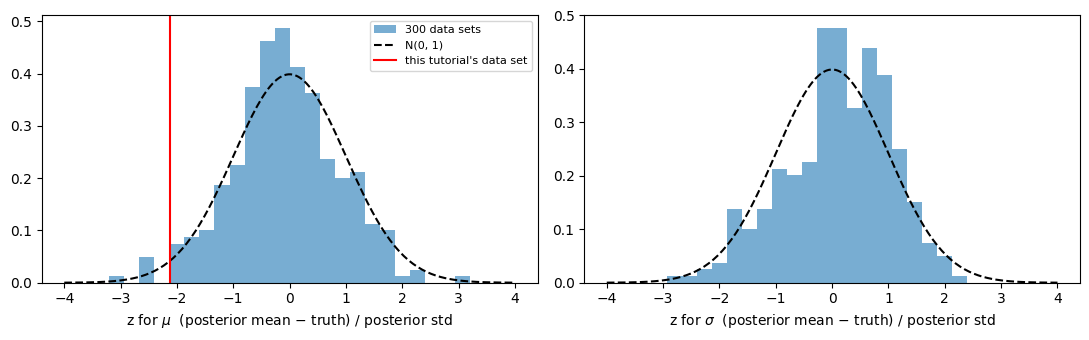
The offsets scatter around zero with unit spread and the credible intervals have the stated coverage: the method is calibrated. The data set used in the sections above (red line) is simply in the tail — about 1 in 20 data sets is at least that far off. The small positive mean \(z\) for \(\sigma\) is expected: with a flat prior the posterior of a scale parameter is right-skewed, so its mean sits slightly above the peak.
This repeated-data test is the idea behind simulation-based calibration (SBC), which is the standard check for likelihood-free and neural inference methods.
Summary
Method |
When to use |
ESS behaviour |
|---|---|---|
|
Proposal already close to posterior |
Degrades quickly if proposal is too broad |
|
Moderate mismatch, iterative refinement |
Better than plain IS; no annealing schedule |
|
Broad prior, multi-modal, or expensive likelihood |
Maintains high ESS via annealing + MCMC move |
All three accept any log_target_fn / log_likelihood_fn and a UniformPrior (or any object with .sample(n) and .log_prob(theta)).